
Buying vs Renting a Shipping Container for Storage: Which Makes Sense?

How to Load and Unload a Shipping Container Safely on Uneven or Sloped Ground
October 7, 2026
The monthly rental fee on a shipping container looks small, which is exactly why so many people end up paying it for far longer than they planned. If you're weighing up whether to buy or rent a shipping container for secure storage in Perth or regional WA, the cheapest-looking option is rarely the lowest total cost once you count delivery, collection, site work, maintenance and resale.
There's also a third option that often gets overlooked: managed off-site container storage, where the container is kept somewhere secure and you never have to find room for it. This guide compares all three on how long you need storage, what each one really costs, who is responsible for the container, how well it suits your site, including the foundation your storage container needs, and how much flexibility you keep. By the end, you should know which option to ask for quotes on, and what those quotes need to include.
Buy vs rent shipping container: the quick rule by storage duration
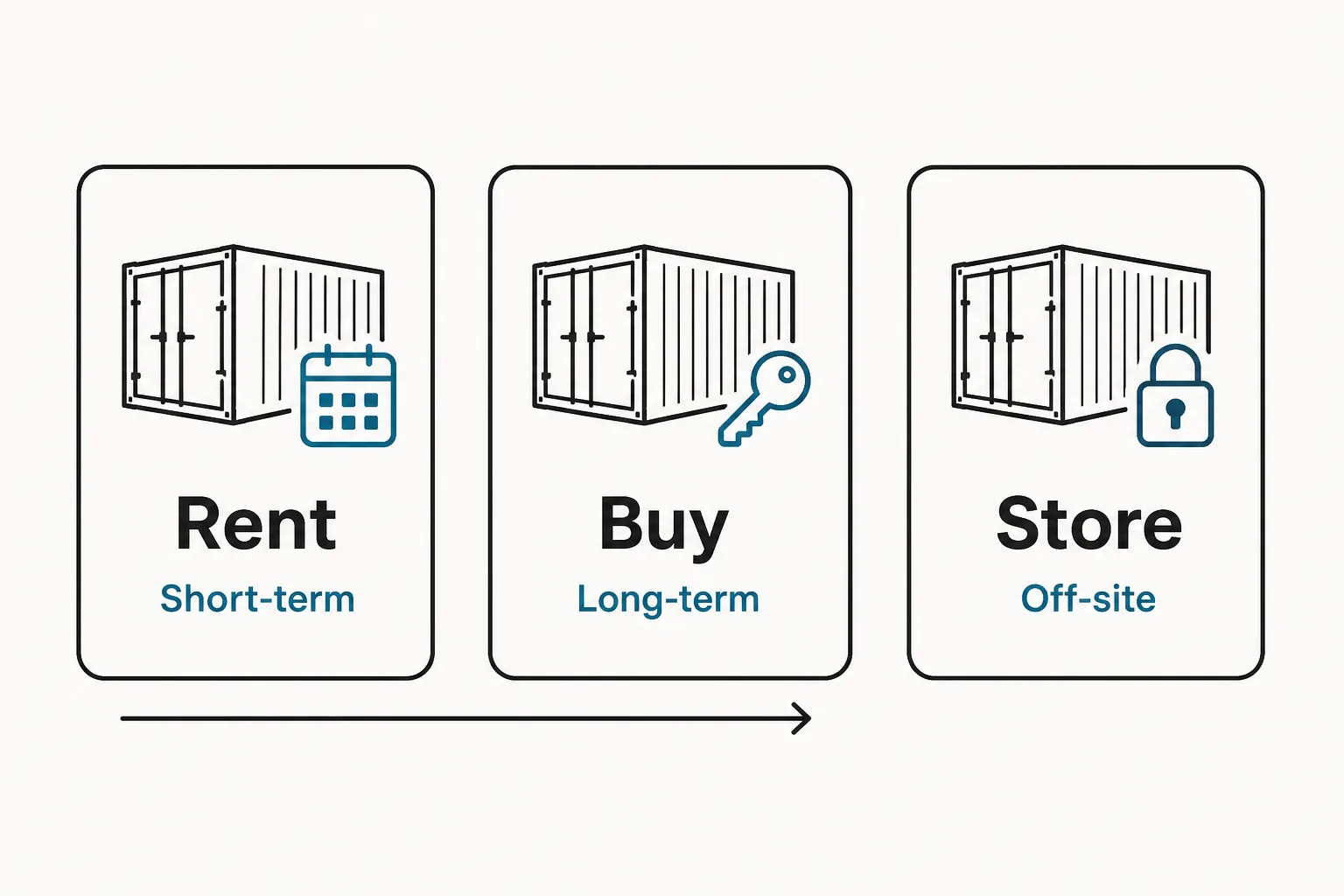
The simplest rule is this: rent when the need is short-term, seasonal or uncertain; buy when it's long-term, stable and likely to repeat; and consider managed container storage when you need goods kept secure but don't want the container on your own property.
The difficulty sits in the middle. Plenty of storage needs start as "a few months" and quietly turn into a year or more, so if there's any chance your term will extend, don't choose on the monthly rate alone. Add up the total rental payments plus delivery and collection (it helps to understand how containers are delivered by tilt tray), then set that against the purchase price, transport, maintenance and a realistic resale figure. Overseas analyses often put the crossover somewhere between four and six months, but WA pricing and transport distances are different, so treat that as a prompt to run your own numbers rather than as a local benchmark.
Managed off-site storage deserves a place in that comparison, because duration isn't the only variable. If space, access, security, strata rules or the upkeep of an owned container are the real obstacles, it can remove most of the problems that make the buy or rent choice difficult in the first place.
Compare the real shipping container storage cost, not just the headline rate
A fair comparison starts with an itemised quote. Whichever option you're pricing, ask to see the upfront purchase price or monthly rental, delivery, collection, any relocation charges, whether a tilt-tray or crane is needed, site preparation, insurance, maintenance and repairs, the cost of any modifications, and any minimum term or early exit fees. The items left off a quote are where the surprises come from.
Buying turns the container into an asset, but the cash outlay is higher and the running costs become yours. Resale value can bring the lifetime cost down considerably, and used containers in sound condition do sell. That said, what you recover depends on the container's condition when you sell, local demand at the time and the effort involved in advertising, showing it to buyers and arranging transport.
Renting keeps money in the business, which matters when you need cash for labour, materials or stock. The catch is that a long rental can quietly overtake the purchase price, particularly once delivery and collection are added. Those two bookend charges can make up a large share of a short hire, and they come round again every time a container goes out to a new job.
Managed storage needs to be judged differently. Its price isn't competing with a container sitting free in your yard; it's competing with the space that container would take up, any access or hardstand work, your security exposure, ongoing maintenance and the cost of eventually removing it. So compare it against those avoided costs rather than against the rental rate alone.
Ownership responsibilities: what changes when you buy instead of rent
When you buy a shipping container for storage, you take on everything that happens to it. That means weatherproofing, door seals, corrosion, repainting, flooring, pest prevention, lock upgrades, ventilation to manage condensation, repairs and, eventually, selling or disposing of it, so it helps to understand what happens to empty sea containers once their shipping life ends. Doors and seals are the usual weak points, and a failed seal can let water in and damage whatever is stored inside.
The trade-off is control. You can paint, rack, light or fit a lockbox to an owned container, or modify it however your operation needs, which makes ownership the natural choice for permanent site storage or repeated operational use. Modifications are only really worth paying for if you own the unit, because that's the only way you keep the benefit.
Renting usually shifts more of the responsibility for condition and replacement to the supplier, so a damaged or worn unit is their problem rather than yours. Rental agreements do commonly restrict painting, cutting, welding or long-term fit-outs, though, so check the terms if you need anything beyond basic shelving.
Whichever way you go, security still needs planning. Placement, good locks, lighting, visibility from the street or yard and insurance cover should all match the value of what you're storing, not the value of the container.
Match the option to your operation, site and access in Perth or regional WA
Renting tends to suit work where the location or volume will change, such as building projects, renovations, seasonal stock, event storage, overflow inventory or temporary farm storage at harvest. When the job ends, the container goes and you get your space back. Buying suits permanent yard storage, repeated use across projects, custom fit-outs and businesses with room to keep the unit, especially operators who can redeploy it rather than leave it sitting idle between jobs.
Before committing to any on-site container, walk the site with delivery in mind. Check that there's enough space and a level hardstand, that a truck can get in and turn around, and that overhead power lines, narrow gates, soft or sandy ground and verge constraints won't get in the way. These factors decide whether you'll need a tilt-tray, side-loader or crane, and that can change the delivery cost significantly, particularly on regional properties.
It's also worth checking council requirements, lease conditions and strata by-laws first, because residential areas, shared industrial complexes and customer-facing premises often have rules about where a container can sit, for how long and how it looks.
Off-site managed storage is often the simpler answer when there's no room on site, theft exposure is high, delivery access is difficult or the site is temporarily congested, or when you'd simply rather keep stored goods in a controlled location than in your driveway or yard. It's worth comparing secure shipping container storage options of this kind against keeping a unit on your own property.
Use this decision checklist before asking for quotes
Choose renting if your need is short, uncertain, seasonal or project-based, or if preserving cash flow matters more to you than building an asset. Choose buying if the need is long-term and repeatable, you want a custom fit-out, and you have suitable space on site to keep and maintain the container. Choose managed container storage if you need secure storage but don't want, or can't have, the unit at your property.
Then answer these questions honestly before you contact a provider:
1. How long will I need storage, and how likely is that to extend?
2. Will I need the same capacity later, or after this project?
3. Can my site take a delivery safely, and what equipment will that require?
4. Who will maintain and secure the unit?
5. Do I need modifications?
6. What happens when I no longer need it?
Once you know which option fits, gather itemised quotes, make sure transport and site costs are included, and compare the total cost over your expected storage term rather than just the monthly rate. If your answers lean to secure off-site storage, Reef Group's container storage Perth service is one option worth pricing; if they point clearly to renting or owning a unit on site, that's the better path to follow.
